
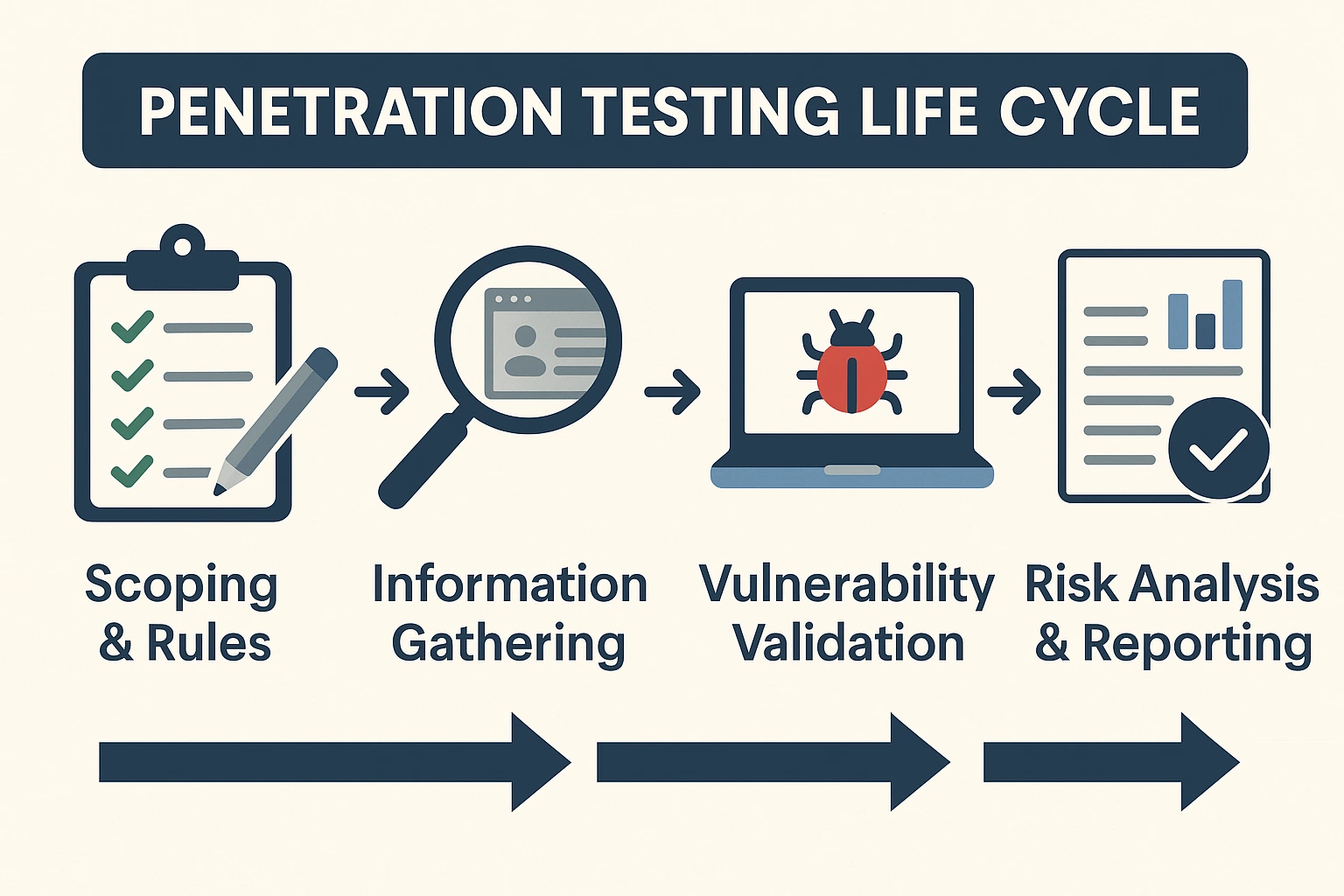
Effective penetration testing hinges on clearly defined objectives and rules of engagement (ROE) established before any testing begins. Within the penetration testing life cycle (PTLC), the ROE prevents scope creep, minimizes operational risk, and ensures activities align with business priorities.
An engagement letter or contract confirms authorization, defines the target systems and networks, sets testing windows, and lists allowed methods as well as stakeholder roles. This upfront agreement keeps testers focused on meaningful security discoveries while the client controls privacy, data ownership, and continuity. The ROE also governs communication, incident handling, and reporting, so both sides have a ready playbook for adverse events or sensitive data exposure.
Rules of engagement specify formal authorization, precise scope, defined testing windows, and acceptable techniques. Testing stays within agreed boundaries, avoids production impact, and refrains from destructive actions or data exfiltration without explicit consent. All tools and methods must be pre-approved and sensitive data must be protected by privacy controls, encryption in transit, and least-privilege access.
A designated point of contact and escalation path are required for incident reporting, with clear SLAs for critical findings. Documentation and evidence gathering should preserve chain of custody, and findings should be delivered in a timely, actionable format. Remediation work follows change management, with retesting planned and documented. If scope changes arise, a formal amendment must be issued and approved.
In the penetration testing life cycle, information gathering and vulnerability assessment form the critical reconnaissance phase that shapes every subsequent action. This stage blends passive data collection, open-source intelligence (OSINT), and targeted discovery to create a realistic picture of an organization's digital landscape. Analysts map an attack surface by cataloging assets, services, external dependencies, and potential entry points while respecting legal boundaries and written authorization. By prioritizing accuracy over speed, teams reduce waste and align testing scope with business risk, compliance requirements, and the organization's risk appetite.
During information gathering, testers gather clues from public records, network banners, IP ranges, domain registrations, and employee publications to identify exposed resources and misconfigurations. In vulnerability assessment, automated scanners and manual review produce a prioritized list of weaknesses, such as misconfigured servers, outdated software, weak credentials, and vulnerable components.
Effective vulnerability assessment combines breadth and depth: broad scanning to reveal surface issues and in depth analysis on critical hosts to validate findings, understand impact, and estimate likelihood. Tools like network scanners, vulnerability scanners, and application security testing suites assist, but human judgment remains essential for contextualizing results and avoiding false positives. Security teams should maintain a living inventory of assets and continuously verify findings against changes in the environment, cloud configurations, and third party integrations. This ongoing validation helps ensure that remediation efforts align with governance, regulatory requirements, and industry standards.
To maximize value, define a data collection and handling policy that limits sensitive information exposure during information gathering. Establish baselines by cataloging assets, authentication methods, and user roles, then track changes over time to spot drift. Apply a risk scoring model that weighs impact, exploitability, and asset criticality. This helps prioritize remediation and determine which findings require formalized penetration testing follow ups. Document testing assumptions, timelines, and exit criteria at the outset to maintain performance discipline.
The exploitation phase in the PTLC is the controlled, authorized attempt to determine whether discovered vulnerabilities can be exploited to gain unauthorized access, escalate privileges, or reach sensitive data. In ethical engagements, testers operate within scope, use limited payloads, and prioritize containment and rollback. Exploitation validates real-world risk, showing practical impact rather than theory. Testers map the exploitation path, initial access, persistence, pivot points, and accessed data, while keeping systems stable. The goal is to quantify exploitability and identify which chains create the greatest business risk.
Risk analysis follows exploitation by blending technical findings with business context. Teams assign likelihood and impact to exploited chains, using a simple framework (critical/high/medium/low or CVSS-inspired). Analysts consider asset criticality, exposure, data sensitivity, and compensating controls. They assess whether access could be elevated to administrator rights, moved laterally, or used to exfiltrate data. Residual risk is estimated after remediation, and priorities are set by business impact and probability. The outcome informs stakeholders what matters and how to defend it, guiding governance and risk decisions.
Deliverables compile exploitation results into actionable artifacts: a comprehensive executive summary, a technical report with vulnerability descriptions, reproduction steps, evidence (screenshots, logs), risk ratings, and a prioritized remediation roadmap. Documentation should include methodology, scope assumptions, and a retention policy for evidence. T
he remediation plan should align with patching, configuration changes, access controls, and compensating measures. A retest plan and closure report complete the lifecycle. All deliverables map to business risk and regulatory requirements, and support stakeholder review and audit.