
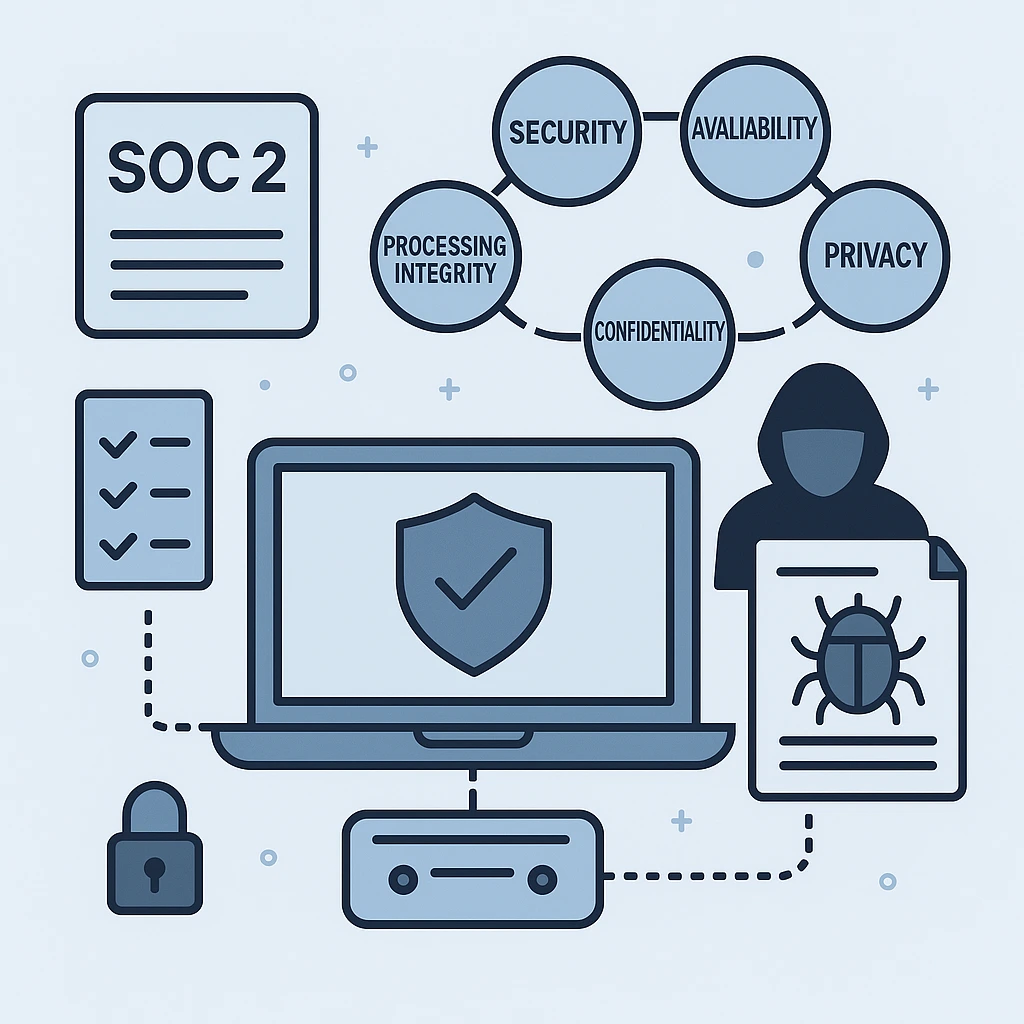
SOC 2 evaluates how a service organization protects the privacy and security of client data. It is built on the five Trust Services Criteria: Security, Availability, Processing Integrity, Confidentiality, and Privacy. The assessment focuses on controls over people, processes, and technology rather than on a single product.
A SOC 2 report describes the system, the controls in place, and how those controls are tested over a defined period. It helps customers understand an organization's risk posture and how data is safeguarded in practice.
Does SOC 2 require penetration testing? Not as an explicit mandate. The standard does not require a formal penetration test, but it does expect an effective vulnerability management program, continuous monitoring, and controls that mitigate risk to acceptable levels. Penetration testing fits within the Security criteria as evidence of testing defenses and remediating weaknesses. Independent testing provides objective validation of your security controls and supports the auditor's assessment of risk. When test results are mapped to control objectives and remediation timelines, they can strengthen the report and increase stakeholder confidence.
To leverage pentesting for SOC 2, treat it as part of a broader risk and vulnerability lifecycle: define engagement rules, target critical assets, test after significant changes, and ensure findings are tracked to resolution. Document the methodology and outcomes clearly for auditors, and communicate how remediation reduces risk for customers.
Many organizations assume that SOC 2 compliance automatically requires a full-blown penetration test. In reality, the SOC 2 framework does not explicitly mandate penetration testing as a standalone control. The authoritative requirements are the Trust Services Criteria for Security, Availability, Processing Integrity, Confidentiality, and Privacy, plus the auditor's interpretation of risk and the system description. Penetration testing is a powerful security activity that exposes weaknesses before attackers do, and it is widely used to validate the effectiveness of controls, hash out configuration errors, and demonstrate due diligence to customers. For service organizations, performing vulnerability assessments and, where appropriate, penetration tests can help verify that access controls, network segmentation, and secure coding practices are robust. But there is no universal 'must' that applies to every SOC 2 report, regardless of environment or scope.
Instead, auditors focus on whether the security controls are suitably designed and operating effectively for the defined scope. If a client's environment includes internet-facing systems, complex integrations, or regulated data, performing penetration testing as part of the risk assessment is prudent and often expected. Some partners or customers may even require penetration test results as part of their vendor management programs.
SOC 2 audits do not prescribe a single penetration testing regime, but they require service organizations to implement and operate controls that protect data and sustain service quality. The Trust Services Criteria (TSC) are outcomes, not techniques, so auditors look for evidence that controls are well designed and operating effectively. Penetration testing and other security testing are common ways to validate that a control environment remains resilient against evolving threats. The following mapping shows how each TSC category translates into testing requirements and the artifacts you would expect in a SOC 2 engagement.
Scope in SOC 2 is the boundary of the services, systems, data, and locations you include in the Trust Services Criteria evaluation. A formal scoping process should map all in‑scope applications, networks, third‑party interfaces, and subservice organizations, along with data flows and risk considerations. So, SOC 2 doesn't require penetration testing, at least not as a formal mandate, however, many organizations incorporate penetration testing and other vulnerability assessments into their security program to provide concrete evidence of controls functioning under real conditions. When used thoughtfully, pen tests validate design and operation and strengthen evidence for your readiness and frequency of testing during the SOC 2 period.
Best practices for scoping frequency include a risk‑based approach and clear triggers for re‑scoping, such as major architecture changes, onboarding of new subservice providers, changes in data types or processing locations, or newly discovered threats. Revisit the scope at least annually, and align it with your change management process so that the description of controls matches the systems being evaluated. For SOC 2 Type II engagements, ensure the scope covers the full measurement period and that any changes are documented with rationale, approvals, and artifacts.